Understand the completed event
Bring ticketing, access, seating, concessions and operational data together to see the KPIs and patterns each source can support.
 CrowdSafeData℠by CrowdSafe Group™Sign in
CrowdSafeData brings authorized ticketing, access, seating, concessions and operational exports into one governed workspace for KPIs, drill-downs, comparisons, source-linked findings and next-event actions.
Need a supported event-data review? Discuss it with CrowdSafe Group →UploadTicketing, access, concessions and operations
✓Map + validateAutomatic matching with review
✓Analyze + actKPIs, drill-downs, findings and next-event actions
✓Bring approved event sources into one controlled workflow without losing provenance, analytical limits or accountability.
Bring ticketing, access, seating, concessions and operational data together to see the KPIs and patterns each source can support.
Drill into time, location, ticket, buyer, product and operational dimensions while keeping associations separate from unproven causes.
Connect each reviewed finding to its source, confidence, limitations, owner and a measurable next-event action.
CrowdSafeData complements the platforms that sell tickets, screen guests, sense movement, model venues and process purchases. Its job begins when event teams need to reconcile those outputs, explain the evidence and own the follow-through.
CrowdSafeData contributionCrowdSafeData preserves the completed-event record so teams can review what happened and what changes next.
CrowdSafeData contributionCrowdSafeData uses approved record-level or aggregate exports to connect buyer and ticket mix with arrival, gate and section outcomes.
CrowdSafeData contributionCrowdSafeData turns measured post-event evidence into a governed action register for the next planning cycle.
Built first for venue and event operations leaders, with shared evidence for ticketing, commercial, safety, security and guest-experience teams.
Works with the stack you already haveRead-only authorized exports from ticketing, screening, sensors, event plans and optional POS—without replacing those systems.
Explains the whole completed eventArrival, gate allocation, access outcomes, buyer mix, ticket products, seating-bowl fill, price points and optional commercial demand in one review.
Makes unknowns visibleMissing fields, unsupported modules, sampled populations and inconsistent denominators stay disclosed instead of becoming confident-looking zeros.
Carries insight into actionEvery reviewed finding can leave with an owner, status, due point and verification criterion for the next comparable event.
This synthetic example shows the decision controls without presenting a real venue, client or operational conclusion.
Evidence: Timestamped aggregate observations identify the strongest interval, the gate’s demand share and the contributing ticket and buyer segments.
Limitation: The capacity comparison uses the declared event-plan allocation and remains an operational diagnostic, not a safety rating.
Next-event action: Test segment-specific arrival messaging, route guidance and flex capacity against the measured pattern.
✓Source and fingerprint recorded
✓Method or rule-set version recorded
✓Confidence shown separately
✓Material limitations disclosed
✓Reviewer and disposition recorded
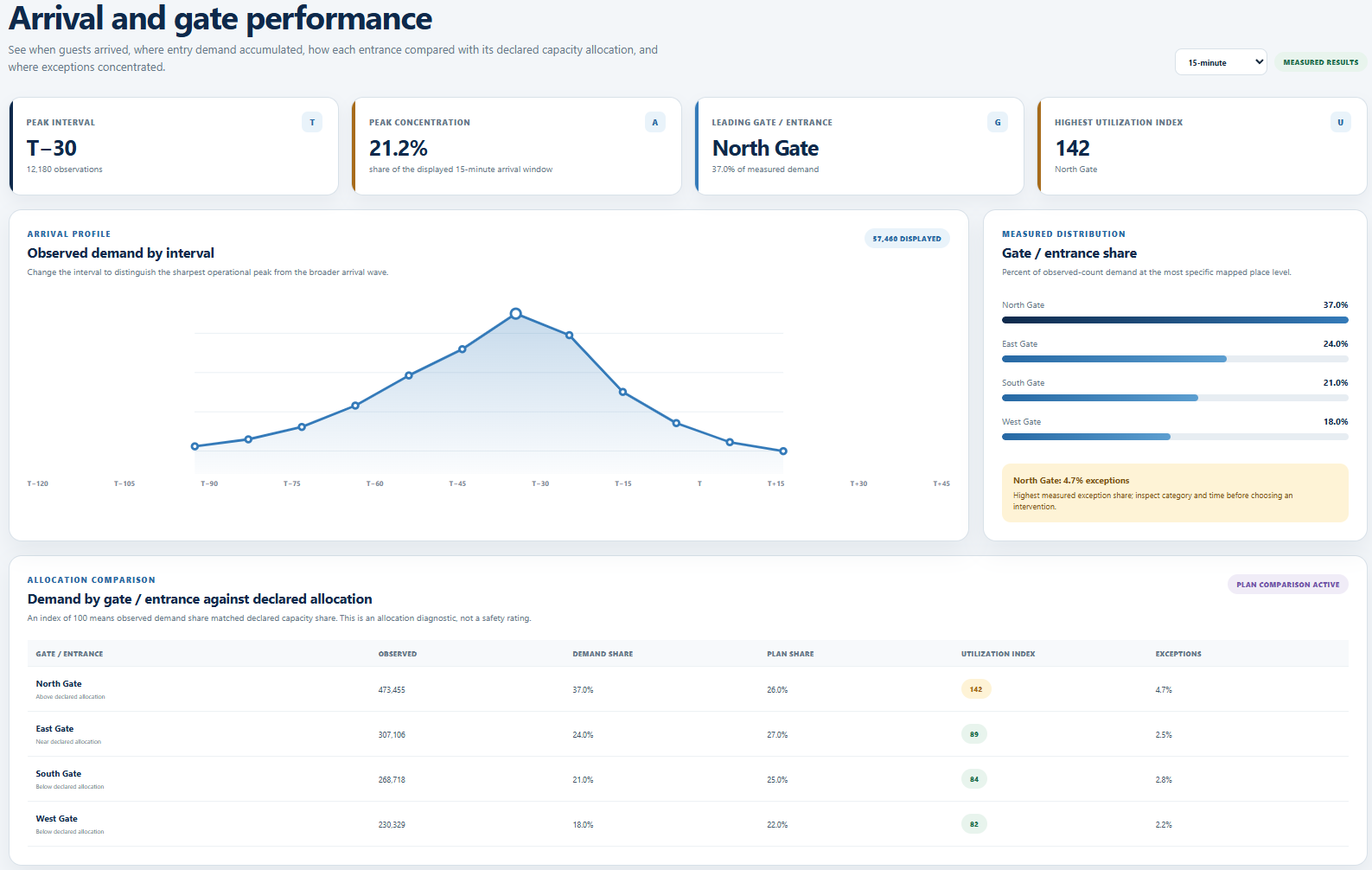 Open full-size dashboard ↗
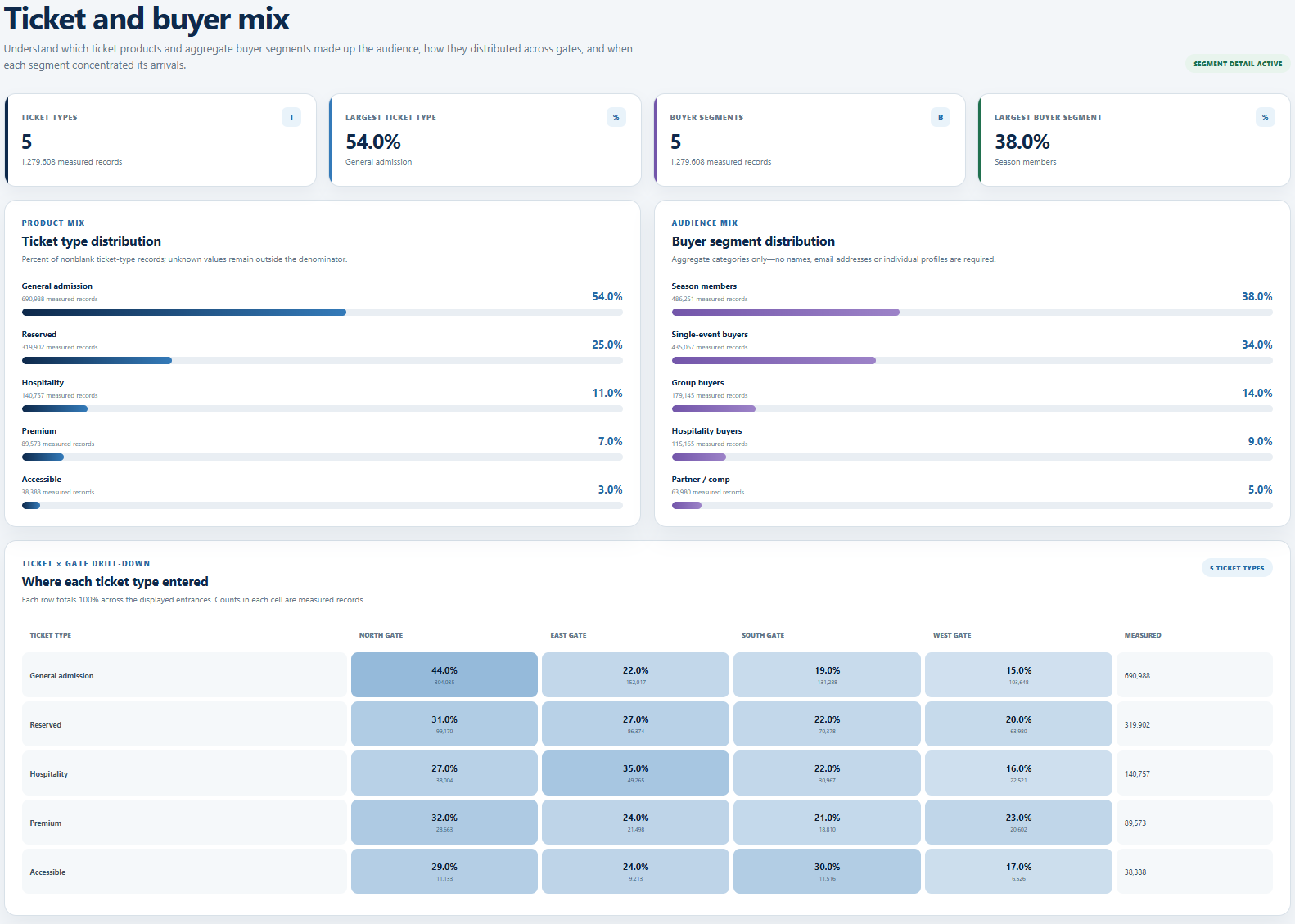 Open full-size dashboard ↗
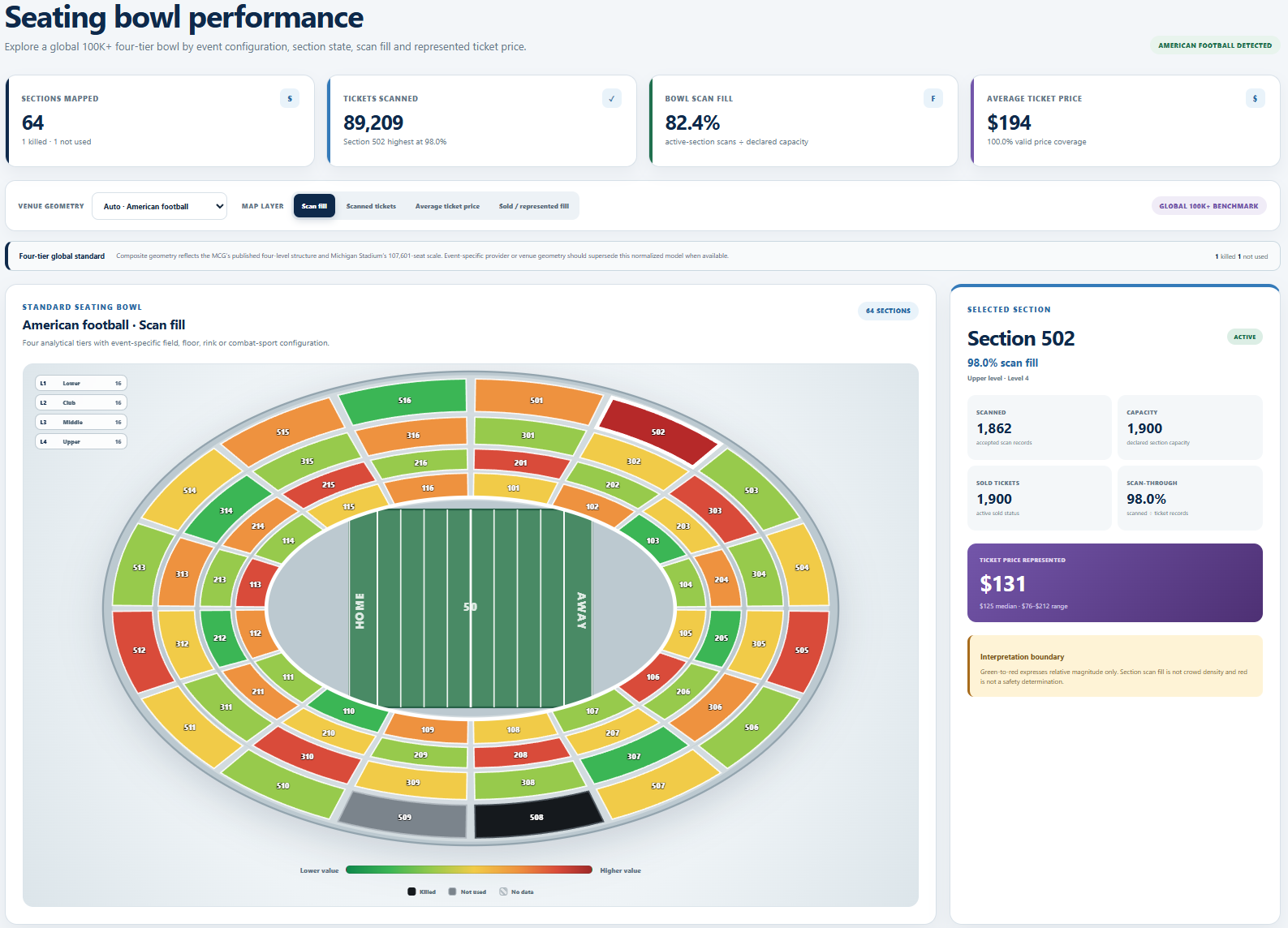 Open full-size dashboard ↗
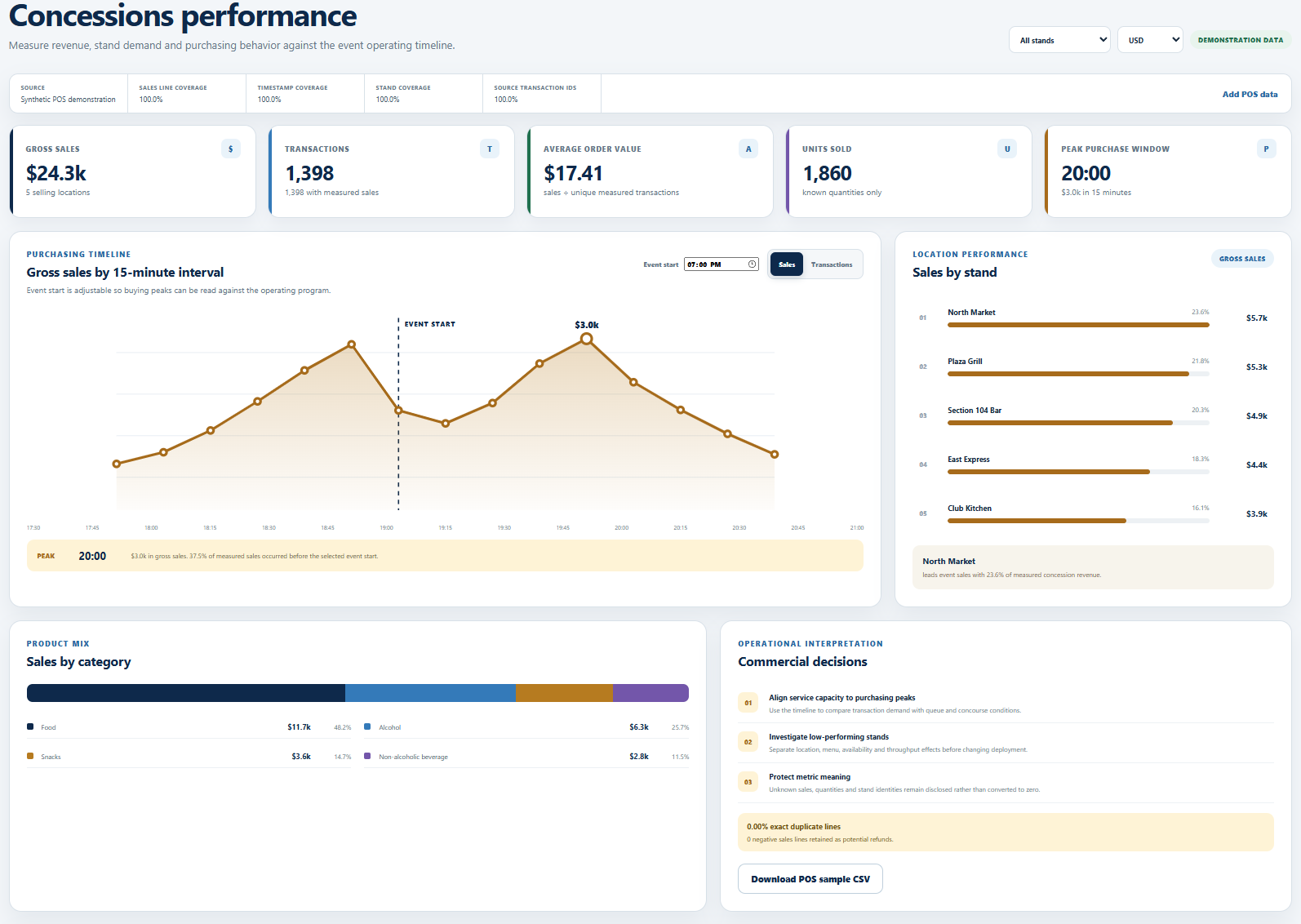 Open full-size dashboard ↗
Demonstration data and interfaces—not client results. Values illustrate supported analytical outputs and do not represent a real venue, event or safety conclusion.
CrowdSafeData separates measured evidence, analytical confidence, client priorities and release decisions so each result can be reviewed on its own terms.
Review security controls →Tenant isolationEach account is provisioned into an organization workspace with scoped projects and source records.
Secure ingestionFiles are fingerprinted, screened for sensitive fields and retained in protected object storage.
Analytical truth contractEvery output carries its source, method or rule-set version, confidence, limitations and review status.
Human-governed findingsUnknown values remain unknown, blocked modules cannot create findings and low-confidence material signals stay in review.
Define the completed event, questions, approved sources and intended decision.
Confirm authorization, structure, coverage and which modules the evidence supports.
Run only eligible modules and keep density as an approved aggregate observation.
Hold low-confidence material signals for human review and disclose every limitation.
Issue the evidence passport, findings and next-event action register.
If preflight shows the available evidence cannot support the requested analysis, we explain the gaps before analysis begins.
CrowdSafeData accepts authorized, read-only post-event exports without requiring a vendor-specific template. Structured files can be profiled immediately; other data formats enter a managed normalization lane while their original source and fingerprint remain preserved. Public-beta ingestion supports individual sources up to 100 GB, subject to the workspace allowance and available storage.
Common structured exports are flattened, typed and profiled immediately.
Other authorized data formats are fingerprinted and held for managed conversion and mapping.
Providers may keep their own field names. Recognized meanings activate governed modules; unfamiliar fields remain usable as reviewed custom dimensions instead of being discarded.
Large files are split into independently verified parts, safely retried and resumed without restarting the transfer, subject to workspace allowance.
For the strongest analysis, include a short description of each file’s grain, field meanings, units, timezone, null conventions and any sensitive-data restrictions. Original provider fields remain visible beside their reviewed analytical mappings.
Start with the export you already have. Unfamiliar fields stay available for text-entered mapping, inferred type review and adaptive analysis instead of being discarded.
Useful fieldsSource grain · timestamps · dimensions · measures · unitsUse aggregate ticket products, buyer segments, scan times, access points, sections, outcome codes, price bands and represented counts.
Useful fieldsTicket type · buyer type · gate · section · outcome · priceUse aggregate lane flow, processing timestamps, throughput, alert categories, secondary-screening outcomes, wait measures and declared service capacity.
Useful fieldsLane · time · outcome · alert class · throughput · capacityUse approved aggregate zone counts, queue observations, dwell intervals, occupancy estimates, sensor confidence, environmental readings and location hierarchies.
Useful fieldsZone · interval · count · queue · dwell · confidence · unitUse transaction-level or aggregate purchasing records, stands, product categories, quantities, prices, discounts, payment types and service intervals.
Useful fieldsTransaction · stand · item · quantity · sales · purchase timeUse capacity plans, section states, staffing counts, transport arrivals, parking, medical or incident categories, weather and any other authorized operational evidence.
Useful fieldsPlace · plan value · role · route · incident class · conditionCompatibility means CrowdSafeData can receive and normalize an authorized export. It does not imply a partnership, endorsement, live integration, platform replacement or autonomous crowd control. Executable and active-content files are blocked.
Approved beta users can upload, map, validate, analyze and review event data at no charge while the beta is active. No card or subscription checkout is required.
Bring authorized event, ticketing, access, concessions and operational exports into one governed workspace.
Use supported KPIs, drill-downs, comparisons and findings without a subscription checkout during beta.
Report data issues and workflow gaps through the traceable support area while the beta team is monitoring production.
Default delivery terms target deletion of raw uploads within 30 days after delivery, normalized analytical records within 90 days and final reports after 12 months. Contracted extensions and legal holds are documented before they apply.
After delivery
Unless contracted otherwise
For accountable follow-through
Defined purpose and approval